How to use OpenShift Templates: The CakePhp example
In this tutorial we will learn how to use Templates on OpenShift, taking as example a simple application which uses the CakePHP framework. This framework consists of a MySQL and PHP set of Images that will deploy a basic Web application.
Step 1: Download the GitHub repository
Firstly, you need a GitHub repository which includes a PHP application. The repository will be used as Source to build the Container image of the CakePHP application.
Head to this repository which contains both OpenShift templates and a sample PHP application: https://github.com/sclorg/cakephp-ex
Fork a copy of the repository locally, so that you can modify the Web application. ( We will cover this point in the second part of this tutorial). For example, in my case, this is the clone of the repository I’m using:
git clone https://github.com/fmarchioni/cakephp-ex.gitThen, before creating resources, make sure you create a namespace for your example:
oc new-project php-demoGreat! now let’s start creating resources.
Step 2: Create an OpenShift application
Firstly, we will deploy the CakePHP-MySQL Template in the current namespace. You can do that with the following command:
$ oc create -f openshift/templates/cakephp-mysql.json
template.template.openshift.io/cakephp-mysql-example created
If you check the above JSON file, you will see that it includes several parameters. One of them is the GitHub Repository of the PHP application:
$ oc describe template cakephp-mysql-example
. . . .
    Name:		SOURCE_REPOSITORY_URL
    Display Name:	Git Repository URL
    Description:	The URL of the repository with your application source code.
    Required:		true
    Value:		https://github.com/sclorg/cakephp-ex.git
As you can see, if we don’t set it, the default Repository will be used instead. To learn how to manage Template parameters, we will create a new application which sets our own Fork Repository.
Create a new OpenShift application as follows:
$ oc new-app --template=cakephp-mysql-example -p SOURCE_REPOSITORY_URL=https://github.com/fmarchioni/cakephp-exThen, wait until all Pods are available. Finally, check the Route to test our application:
$ oc get route
NAME                    HOST/PORT                                         PATH   SERVICES                PORT    TERMINATION   WILDCARD
cakephp-mysql-example   cakephp-mysql-example-php-demo.apps-crc.testing          cakephp-mysql-example
Verify that the application is available at that Route address:
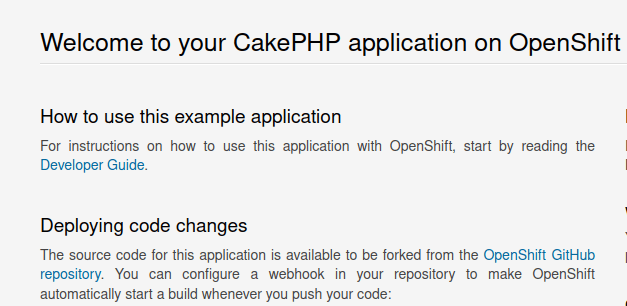
Finally, to clean up the resources from this example you can run the following commands:
# delete all application resources
oc delete all --all

# delete the opaque secret
oc delete secret cakephp-example

# delete the openshift template
oc delete template cakephp-mysql-examp
How to customize the CakePHP Template
In order to modify the OpenShift template of our application we need to edit the file cakephp-mysql.json which contains the Resources for our CakePHP application.
For example, we will add another Template parameter “WELCOME” that our application will use:
{
       "name": "WELCOME",
       "displayName": "Welcome message",
       "description": "The welcome message.",
       "value": "Hello there"
}
Then, we need to provide the above parameter to the DeploymentConfig of the application. Search for the cakephp-mysql-example DeploymentConfig and include the WELCOME environment variable in it:
"spec": {
            "containers": [
              {
                "name": "cakephp-mysql-example",
                "image": " ",
                "ports": [
                  {
                    "containerPort": 8080
                  }
                ],
. . . . .
                },
                "env": [
                 {
                    "name": "WELCOME",
                    "value": "${WELCOME}"
                  },
If you have deleted your Template at the end of the first example, make sure you are creating it again:
oc create -f openshift/templates/cakephp-mysql.jsonThen, our PHP application must be able to read the above Parameter as Environment variable. For example, edit the src/Template/Layout/default.ctp and replace the static H1 Header with the following one:
<hgroup>
           <h1><?=  getenv("WELCOME") ?>  </h1>
</hgroup>
Commit the above change in your GitHub Fork before creating again your application.
Finally, re-create your application including the additional Template parameter “WELCOME”:
oc new-app --template=cakephp-mysql-example -p SOURCE_REPOSITORY_URL=https://github.com/fmarchioni/cakephp-ex -p WELCOME=BuongiornoAs you can see from the new CakePHP Home page, the WELCOME parameter displays in the Header:
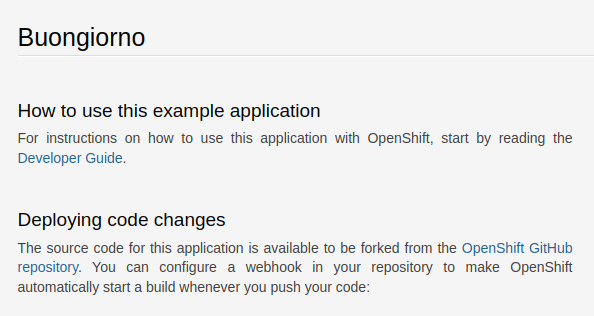
Conclusion
In this tutorial, we have explored how to use OpenShift templates, with a specific focus on the CakePHP template as an example. OpenShift templates provide a powerful and efficient way to define, manage, and deploy complex applications within an OpenShift cluster. By following the steps outlined in this tutorial, you should now have a solid understanding of the key concepts and processes involved in using OpenShift templates with CakePHP or similar applications.
Recommended Articles
Deploying Custom Docker Images in OpenShift using Source-to-Image (S2I) - A Step-by-Step Guide
Learn how to build and deploy custom Docker images on OpenShift using S2I. This tutorial covers the process of loading a Docker image from Docker Hub, creating a new Docker image with S2I, and deploying it to OpenShift.
Build and Deploy a Jakarta EE Application on OpenShift: A Step-by-Step Guide
Learn how to deploy a Jakarta EE application on OpenShift, including installing Code Ready Containers and setting up the environment.
Deploying Enterprise Applications on Openshift using Binary Builds
Learn how to deploy Java EE applications on OpenShift using a binary build, leveraging WildFly 13.0.0.Final. Get started with this step-by-step guide.
Deploying a Java EE Application on WildFly with OpenShift Container Platform
Learn how to deploy a Java EE application on WildFly using OpenShift Container Platform, including creating a project and customizing the database.