Architecting MapStruct + Lombok: Fixing "Unmapped Target Property" and Annotation Processor Clashes
In modern Java development, pairing Project Lombok with MapStruct is the industry-standard recipe for eliminating repetitive boilerplate. Lombok automatically generates your getters, setters, constructors, and builders at compile time; MapStruct intercepts those generated methods to build high-performance, reflection-free object mappers.
However, because both frameworks operate during the compilation phase using the Java Annotation Processing API (JSR 269), they are highly susceptible to compiler race conditions. If the MapStruct processor executes before Lombok has finished modifying the Abstract Syntax Tree (AST), MapStruct will analyze raw, getterless source files. The result is a build failure: fields are silently mapped as null, or the compiler throws the dreaded "Unmapped Target Property" error.
This guide resolves these compiler clashes, detailing the precise build configuration, builder overrides, and target mapping strategies required to keep your build pipeline deterministic and clean.
Prerequisites
To implement and run the examples in this guide, ensure your environment meets the following baseline:
- Java Development Kit (JDK): Version 17 or 21
- Build Tool: Apache Maven 3.8.1+ (or Gradle 7.0+)
- Lombok: Version 1.18.16 or higher (specifically using 1.18.32+ for modern JDKs)
- MapStruct: Version 1.6.3
Step 1: Enforcing Compilation Order in pom.xml
By default, the Java compiler does not guarantee the execution sequence of annotation processors. To force coordination, you must explicitly declare the processors inside your build plugin and include the lombok-mapstruct-binding coordinator artifact. This binding layer instructs MapStruct to yield execution until Lombok has finished enriching your data beans.
Here is the production-ready <build> configuration for Apache Maven:
<properties>
    <maven.compiler.source>17</maven.compiler.source>
    <maven.compiler.target>17</maven.compiler.target>
    <org.mapstruct.version>1.6.3</org.mapstruct.version>
    <org.projectlombok.version>1.18.32</org.projectlombok.version>
    <lombok-mapstruct-binding.version>0.2.0</lombok-mapstruct-binding.version>
</properties>

<dependencies>
    <dependency>
        <groupId>org.mapstruct</groupId>
        <artifactId>mapstruct</artifactId>
        <version>${org.mapstruct.version}</version>
    </dependency>
    <dependency>
        <groupId>org.projectlombok</groupId>
        <artifactId>lombok</artifactId>
        <version>${org.projectlombok.version}</version>
        <scope>provided</scope>
    </dependency>
</dependencies>

<build>
    <plugins>
        <plugin>
            <groupId>org.apache.maven.plugins</groupId>
            <artifactId>maven-compiler-plugin</artifactId>
            <version>3.13.0</version>
            <configuration>
                <annotationProcessorPaths>
                    <!-- 1. Lombok must be listed first to generate AST nodes -->
                    <path>
                        <groupId>org.projectlombok</groupId>
                        <artifactId>lombok</artifactId>
                        <version>${org.projectlombok.version}</version>
                    </path>
                    <!-- 2. The binding layer enforces coordination -->
                    <path>
                        <groupId>org.projectlombok</groupId>
                        <artifactId>lombok-mapstruct-binding</artifactId>
                        <version>${lombok-mapstruct-binding.version}</version>
                    </path>
                    <!-- 3. MapStruct compiles the mappers using Lombok's metadata -->
                    <path>
                        <groupId>org.mapstruct</groupId>
                        <artifactId>mapstruct-processor</artifactId>
                        <version>${org.mapstruct.version}</version>
                    </path>
                </annotationProcessorPaths>
            </configuration>
        </plugin>
    </plugins>
</build>
Note: For Gradle environments, declare your compilation dependencies using annotationProcessor in the exact same sequence:
dependencies {
    implementation "org.mapstruct:mapstruct:${mapstructVersion}"
    compileOnly "org.projectlombok:lombok:${lombokVersion}"
    annotationProcessor "org.projectlombok:lombok-mapstruct-binding:0.2.0"
    annotationProcessor "org.mapstruct:mapstruct-processor:${mapstructVersion}"
    annotationProcessor "org.projectlombok:lombok:${lombokVersion}"
}
Step 2: Defining Lombok POJOs with Target Policies
To safeguard our REST and database layers, we want to enforce strict compilation checks. If a DTO introduces a new property that isn't mapped to our domain entity, we want the compiler to throw an error immediately—rather than letting it slip into production as a silent mapping gap.
Let's model an InventoryItem domain entity and its corresponding transfer DTO.
Domain Entity (Source)
package com.architect.model;

import lombok.Data;
import lombok.NoArgsConstructor;
import lombok.AllArgsConstructor;

@Data
@NoArgsConstructor
@AllArgsConstructor
public class InventoryItem {
    private String sku;
    private String productName;
    private int stockCount;
    private double unitPrice;
}
Transfer DTO (Target)
package com.architect.dto;

import lombok.Data;

@Data
public class InventoryItemDto {
    private String skuId;         // Mismatched field name (sku -> skuId)
    private String productName;   // Matching field name
    private int quantity;         // Mismatched field name (stockCount -> quantity)
    private double unitPrice;     // Matching field name
    private String internalCode;  // Unmapped field
}
Step 3: Resolving "Unmapped Target Property" Errors
We define our MapStruct mapper with a strict policy: unmappedTargetPolicy = ReportingPolicy.ERROR. This ensures that any missing or misconfigured property mapping halts our Maven compilation.
package com.architect.mapper;

import com.architect.dto.InventoryItemDto;
import com.architect.model.InventoryItem;
import org.mapstruct.Mapper;
import org.mapstruct.Mapping;
import org.mapstruct.ReportingPolicy;
import org.mapstruct.factory.Mappers;

@Mapper(unmappedTargetPolicy = ReportingPolicy.ERROR) // Halts build on unmapped targets
public interface InventoryItemMapper {
    InventoryItemMapper INSTANCE = Mappers.getMapper(InventoryItemMapper.class);

    @Mapping(source = "sku", target = "skuId")
    @Mapping(source = "stockCount", target = "quantity")
    // Target "internalCode" is unmapped!
    InventoryItemDto toDto(InventoryItem entity);
}
The Compilation Fail
When you run mvn clean compile, the compiler will fail with the following diagnostic message:
[ERROR] /com/architect/mapper/InventoryItemMapper.java:
Unmapped target property: "internalCode".
The Correction
To satisfy our strict compilation checks, we must explicitly declare how to handle the unmapped property. We can map it to a constant, assign an expression, or explicitly ignore it using ignore = true.
@Mapper(unmappedTargetPolicy = ReportingPolicy.ERROR)
public interface InventoryItemMapper {
    InventoryItemMapper INSTANCE = Mappers.getMapper(InventoryItemMapper.class);

    @Mapping(source = "sku", target = "skuId")
    @Mapping(source = "stockCount", target = "quantity")
    @Mapping(target = "internalCode", ignore = true) // Explicitly ignored to pass validation
    InventoryItemDto toDto(InventoryItem entity);
}
Alternatively, if you are mapping a large target DTO but only care about extracting a few select fields, you can bypass the default behavior by configuring explicit mapping. Setting ignoreByDefault = true tells MapStruct to skip any target field that is not explicitly defined with a @Mapping annotation:
@Mapper(unmappedTargetPolicy = ReportingPolicy.ERROR)
public interface ExplicitInventoryMapper {

    @BeanMapping(ignoreByDefault = true) // Disables implicit name matching
    @Mapping(source = "sku", target = "skuId")
    @Mapping(source = "productName", target = "productName")
    InventoryItemDto toPartialDto(InventoryItem entity);
}
Step 4: Lombok Builder Conflicts and @MappingTarget
Lombok’s @Builder annotation is incredibly clean, but it introduces an unexpected trap when paired with MapStruct.
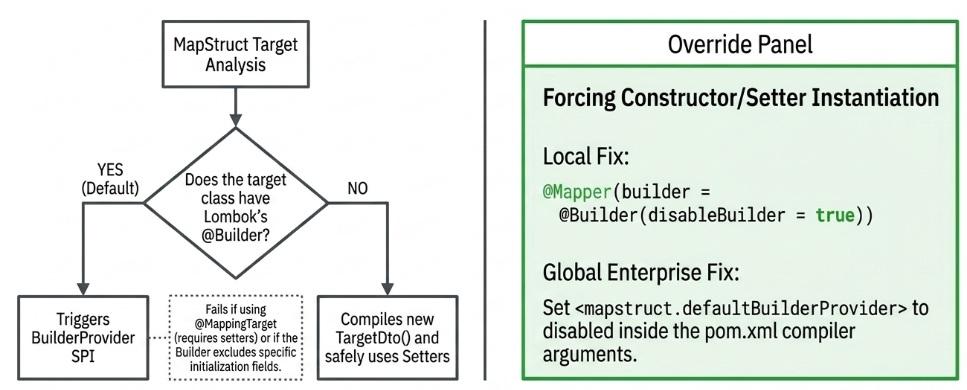
When MapStruct detects a class annotated with @Builder, its BuilderProvider automatically shifts its code generation strategy. Instead of instantiating the target class via a parameterless constructor and calling setters, it attempts to construct the object using the generated builder pattern.
The Conflict: In-Place Updates (@MappingTarget)
This causes a critical compilation failure when you write update methods (annotated with @MappingTarget). An update method is designed to take an existing object instance and update its state in place, which requires setter methods. If MapStruct is forced to use a builder, it cannot update the existing instance directly; it would have to build a brand-new object, which violates the @MappingTarget design.
Let's look at a domain entity configured with @Builder:
package com.architect.model;

import lombok.Builder;
import lombok.Getter;

@Builder
@Getter
public class UserProfile {
    private String email;
    private String fullName;
}
If we try to write an in-place update method:
@Mapper
public interface UserMapper {
    // Maps to an existing instance
    void updateProfileFromDto(UserProfileDto dto, @MappingTarget UserProfile profile);
}
The compilation fails because Lombok's @Builder has stripped the setters, and MapStruct cannot utilize a builder chain on an existing instantiated target bean.
Resolving the Builder Conflict
You can resolve this two different ways:
Option A: Disable Builder Detection Locally in the Mapper
You can instruct MapStruct to completely bypass Lombok’s builder for a specific mapper interface by configuring the @Builder annotation parameter inside @Mapper:
@Mapper(builder = @org.mapstruct.Builder(disableBuilder = true)) // Forces standard setter mapping
public interface UserMapper {
    void updateProfileFromDto(UserProfileDto dto, @MappingTarget UserProfile profile);
}
Option B: Disable Builders Globally via Compiler Options
If your entire codebase relies on @MappingTarget in-place updates, you can pass a global compiler flag to the maven-compiler-plugin configuration to disable MapStruct builder parsing entirely:
<compilerArgs>
    <arg>-Amapstruct.disableBuilders=true</arg>
</compilerArgs>
Edge Cases & Pitfalls
1. The Clean Build Requirement during Lombok Refactoring
When you change property names or types inside Lombok-annotated source classes, IDE incremental compilers occasionally fail to re-execute both annotation processing rounds.
- The Symptom: Your IDE reports compilation errors, even though the code looks perfectly aligned.
- The Fix: Always execute a full clean build to wipe target directories and force execution order:
mvn clean compile
2. Null Safety with Custom @AfterMapping Hooks
When MapStruct uses a builder pattern, the lifecycle behavior changes. If you have a custom @AfterMapping hook targeting the final target bean, the hook will execute after the builder finishes constructing the target instance. However, if you need to mutate fields prior to construction, your hook must accept the Lombok builder class as the @MappingTarget parameter:
@AfterMapping
protected void modifyBuilder(UserProfileDto dto, @MappingTarget UserProfile.UserProfileBuilder builder) {
    // Enforces custom uppercase values on the builder state before .build() is called
    builder.email(dto.getEmail().toLowerCase());
}
Conclusion
By introducing the lombok-mapstruct-binding coordinator into your compiler configuration, you establish a deterministic pipeline where Lombok is guaranteed to enrich your AST before MapStruct inspects it. Pair this compile-time sequencing with a strict unmapped target reporting policy, and you prevent unmapped silent field gaps from ever leaking past your CI/CD pipelines.
Recommended Articles
Mastering MapStruct Compilation Errors in Enterprise Java Applications
Learn how to resolve common MapStruct compile-time errors and ensure your Maven/Gradle builds succeed. #MapStruct #Java #EnterpriseJava #CompileTimeErrors
Architecting MapStruct with Spring Boot 3: Complete Integration Guide
Master MapStruct with Spring Boot 3. Build a type-safe, compile-time mapping pipeline using Spring 6, dependency injection, and the Conversion Service.
Mastering Collection Mapping with MapStruct: A Comprehensive Guide
Learn how MapStruct simplifies collection conversions between domain entities and DTOs. Customize mappings and handle null vs. empty collections efficiently.
Advanced MapStruct Features: Mapping from Multiple Sources and Using Java Expressions
Advanced MapStruct 1.6.3 tutorial: mapping from multiple sources, Java expressions, @AfterMapping, nested mappings, custom methods, and common compile-time pitfalls.